Allocation strategies
Definitions of common allocation approaches referenced in TRINITY education materials.
Kelly Criterion
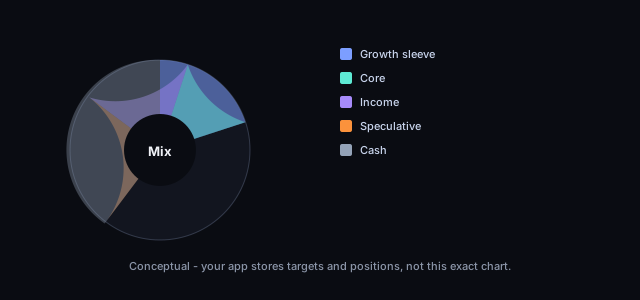
A sizing framework from probability theory. TRINITY may expose Kelly-style controls for advanced users. It is mathematically demanding and can suggest aggressive sizing—many practitioners use fractional Kelly (e.g. half or quarter Kelly) to dampen drawdowns.
Caveats: Edge and win-rate estimates are noisy; small errors in inputs explode suggested size. Treat Kelly as a thought experiment unless your firm has validated inputs and limits.
Equal weight
Assigns the same weight to each position. Simple to explain and audit; may under-weight stronger opportunities and over-weight illiquid or volatile names if you do not cap universe quality.
Best for: transparent benchmarks, teaching, and baseline comparisons before adding tilts.
Confidence weighted
Increases weight where model or user confidence is higher. Requires understanding how confidence is derived in the product—it reflects model consistency, not guaranteed outcomes. See Analysis and symbol pages for how confidence appears in IRIS.
Stage weighted
Uses stage analysis labels (e.g. accumulation, markup, distribution, decline) to tilt exposure. Stages are model outputs and can be wrong; use as one input among many. Combine with sector limits, liquidity, and max position size.
Hierarchical risk parity (concept)
Advanced risk budgeting that clusters similar risks before allocating. When referenced in product copy, treat it as an educational analogy unless a specific implementation is documented in release notes.
Optimization vs manual allocation
DIONYSUS optimization (via Optimize portfolio in IRIS) searches for feasible portfolios under your constraints—see Portfolio optimization with DIONYSUS and DIONYSUS allocation strategies in depth. Manual allocation follows your own rules without the solver. Many users blend both: optimization for ideas, manual overrides for ethics, taxes, or concentration policy.
Checklist before adopting a strategy
- Write down the objective (growth, income, learning, benchmark tracking).
- Set caps (positions, sector, single-name max, drawdown tolerance).
- Paper-trade or use demo portfolios when available.
- Revisit after major regime changes (rates, volatility, correlation breakdowns).
Nothing here is tax, legal, or investment advice—see Disclosures.
Further reading (DIONYSUS)
Progress is saved in this browser. Cloud sync requires PUBLIC_IRIS_API_BASE, IRIS CORS allowlist,
and window.__trinityIdToken.