Analysis, batch jobs, and symbol pages
Stages, confidence, batch analysis, and how ATHENA outputs surface in IRIS—without performance promises.
The symbol page as the analysis hub
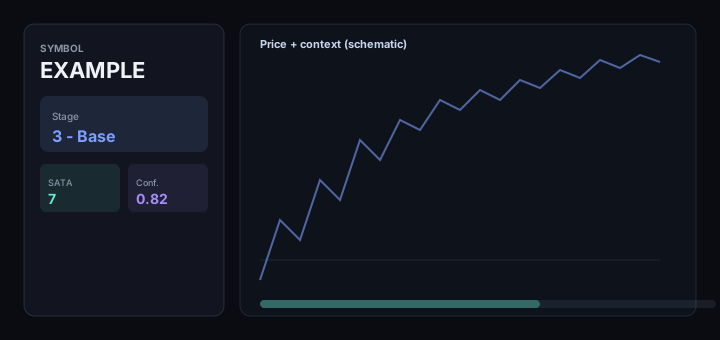
Each /symbol/<SYMBOL> page aggregates:
- Price and market data (HERMES and related feeds)—subject to delay and correction.
- ATHENA-derived signals—stages, indicator bundles (e.g. momentum, relative strength concepts, composite scores where exposed), and confidence fields that describe model certainty, not a promise of profit.
- Links to portfolio and watchlist actions, optional context summaries where the product enables them, and paths into batch or Hunt workflows.
Treat the symbol page as a research cockpit: it consolidates inputs; it does not replace fundamental work or risk policy.
Stages and confidence (product semantics)
Stage labels summarize where a model places a security within a cycle-style framework. The four stages are Accumulation (1), Markup (2), Distribution (3), and Markdown (4). Labels can be wrong, late, or unstable around earnings and regime shifts.
For a complete explanation of what each stage means, including sub-stages and how stage transitions work, see:
- Market cycles and stages — overview and navigation hub
- Understanding stage analysis — deep dive into the 4-stage cycle, limitations, and responsible use
Confidence (when shown) is a normalized model output. Higher confidence means the model is more internally consistent with its inputs—not that the trade will win.
Never size positions from stage or confidence alone.
SATA score and technical confirmation
Alongside stage labels, symbol pages may show a SATA score (0–10)—a composite of ten technical indicator components measuring how strongly indicators confirm the stage classification. SATA 7+ indicates strong confirmation; SATA 4–6 indicates developing confirmation.
See The SATA score for a complete breakdown of all ten components.
Mansfield Relative Strength
Symbol pages may also display Mansfield RS—a measure of the stock’s performance relative to the SPY benchmark over the past 52 weeks. Positive RS means the stock is outperforming the market; negative means it’s underperforming. RS is a SATA component and an important qualifier for signal quality.
See Relative strength and Mansfield RS for interpretation guidance.
Signals: BUY, ADD, HOLD, REDUCE, SELL
ATHENA generates one of five signals for each analyzed symbol: BUY, ADD, HOLD, REDUCE, or SELL. Each signal reflects a combination of stage classification, SATA confirmation, Mansfield RS, and model confidence. Signals include a confidence tier (HIGH / MODERATE / LOW) and an analysis timestamp.
Always check the analysis timestamp—signals degrade in relevance as time passes.
See Reading trading signals for the full signal logic and responsible use guidelines.
Patterns, transition probabilities, and key levels
Beyond the five-letter signal, symbol pages often include:
- Pattern Analysis (recent formations, Best Pattern, and Pattern Direction such as bullish or bearish tilt)—see Patterns and structure on the symbol page.
- Stage Transition Probabilities (percentages summarizing modeled emphasis between stages)—see Stage transition probabilities.
- Support, resistance, price targets, volatility, and sector when ATHENA exposes them for that symbol—same freshness and data-quality caveats as the rest of the card.
Pattern direction and transition percentages can disagree with AI Signal; that is expected when pattern-only reads and full signal gates tell different stories.
Where ATHENA sits in your process
For a short map from market data → ATHENA → your rules → optional automation, see How ATHENA fits your trading process.
Batch analysis
The batch analysis area in IRIS drives multi-symbol ATHENA refreshes. Use it when you want many names updated for the same review (screening, portfolio-wide checks).
Operational expectations:
- Large batches may queue—progress indicators in the UI reflect pipeline state.
- Failures on individual symbols should not silently drop the whole job; check per-symbol status when the UI offers it. For empty cards or odd one-off misses, see FAQ & troubleshooting.
- Results use the same stage / indicator / signal vocabulary as single-symbol pages.
Automation and timing: If you use automated trading, it runs on a separate schedule from batch analysis. A symbol’s stage can update after a trade when fresh ATHENA work completes—that usually reflects new analysis time, not an execution bug. See How ATHENA fits your trading process and Reading automation decision logs.
Relating to Hunt and optimization
- Hunt answers “what might improve this portfolio?” using ARTEMIS logic—see Hunt, Cash Hunt, and optimization.
- Optimization (DIONYSUS) proposes weights and trades under constraints you set in portfolio settings—see Portfolio optimization with DIONYSUS.
Analysis informs both; neither replaces human judgment.
Data quality and disclaimers
Corporate actions, splits, halts, and bad prints can distort indicators briefly. If a symbol looks inconsistent, verify corporate action history and data vendor notes before acting.
All analysis is educational and informational within TRINITY’s terms—not personalized advice.
Further reading
- Patterns and structure on the symbol page — pattern list, pattern direction vs AI Signal, levels and targets
- Stage transition probabilities — reading the transition panel responsibly
- Understanding stage analysis — the complete 4-stage framework
- The SATA score — technical confirmation scoring
- Relative strength and Mansfield RS — relative performance explained
- Reading trading signals — signal logic and responsible use
- Technical indicators guide — plain-language indicator reference
- How TRINITY AI works — the ML model behind stage and signal generation
- Understanding market conditions — how market regime affects analysis
- A stage-based investing approach — putting it all together
- FAQ & troubleshooting — staleness, batch behavior, missing analysis
Progress is saved in this browser. Cloud sync requires PUBLIC_IRIS_API_BASE, IRIS CORS allowlist,
and window.__trinityIdToken.