Risk management fundamentals
Core controls available in portfolio workflows—explained for education only.
Max risk per trade
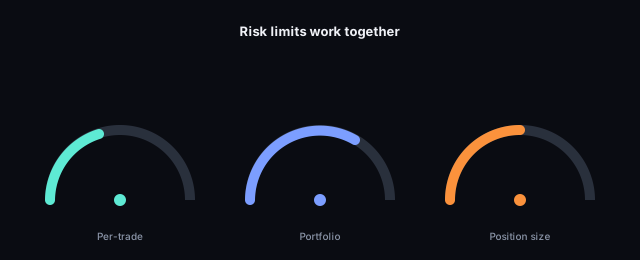
Caps how much of the portfolio may be lost on a single position under modeled scenarios. Lower values are more conservative. This is a control, not a guarantee of maximum loss in extreme markets (gaps, halts, geopolitical shocks).
Max portfolio risk
Limits aggregate modeled risk across holdings. Use alongside diversification, liquidity, and correlation awareness—models often underestimate tail dependence.
Position count and size caps
Max positions encourages diversification. Max position size reduces single-name concentration. Together they shape how optimization and Hunt search the feasible set. If suggestions feel repetitive, widen the universe or tighten liquidity filters before raising caps.
Settings surfaces in IRIS
Update caps and presets from your portfolio screens in IRIS (risk settings and related controls). If documentation and UI disagree, trust the in-app labels and file a bug.
Integrators: risk-setting fields in the API mirror what you see in IRIS—see the Developers portal for schemas.
Rebalancing discipline
Rebalancing can reduce drift but may realize gains/losses and incur costs. Product defaults are starting points—adjust to your constraints, tax situation, and transaction costs.
Behavioral risks
- Over-trading after losses (revenge trading).
- Ignoring cash needs and emergency funds.
- Trusting a single indicator or stage label in isolation.
Pair TRINITY with a written investment policy statement if you manage meaningful capital.
Related guides
- Your portfolio in TRINITY — how caps and cash interact in the portfolio record
- Portfolio basics
- Portfolio optimization with DIONYSUS — how
max_risk_per_tradeand related fields bind sizing - Hunt, Cash Hunt, and optimization
- Automated trading (ARES) — scheduled execution still honors these caps when configured correctly
- Disclosures
Progress is saved in this browser. Cloud sync requires PUBLIC_IRIS_API_BASE, IRIS CORS allowlist,
and window.__trinityIdToken.