Technical indicators guide
A plain-language reference for every technical indicator used by TRINITY's ATHENA engine—what it measures, how to interpret it, and how it connects to stage analysis.
How to use this guide
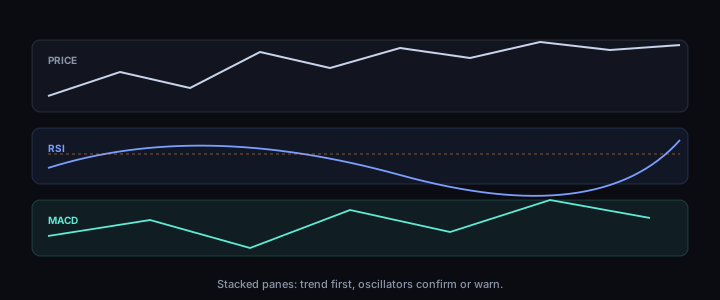
ATHENA computes a large set of technical indicators when analyzing each symbol. These indicators feed into the SATA score, the trading signals, and the underlying AI model’s feature vector. Understanding what each indicator measures—and what it doesn’t—makes you a more informed reader of TRINITY’s analysis.
Indicators work best in combination. The cardinal rule in TRINITY’s design: no single indicator drives a signal; multiple independent measures must agree before the model commits to a recommendation.
Moving averages
Simple Moving Average (SMA)
An SMA averages the closing price over a specified number of days. It removes day-to-day noise and reveals the underlying trend direction.
| Period | Common name | What it captures |
|---|---|---|
| 10-day | Short-term MA | Near-term price momentum |
| 20-day | Intermediate MA | Short-to-medium trend |
| 50-day | Medium-term MA | Intermediate institutional trend |
| 200-day | Long-term MA | The primary long-term trend |
TRINITY use: All four SMA periods are SATA components 1–4. Being above the 200-day SMA is a foundational requirement in Weinstein’s methodology for Stage 2 classification. A stock trading below its 200-day is, by definition, not a classic Stage 2 candidate.
Interpretation tip: The more SMA levels a stock is above, the more aligned and sustained the uptrend is. Trading above all four (10/20/50/200) is a “full stack” aligned uptrend.
Exponential Moving Average (EMA)
An EMA applies more weight to recent prices, making it faster to react to new price data than a simple average. TRINITY uses EMAs for shorter-period calculations where responsiveness matters more than smoothness.
RSI — Relative Strength Index
Created by: J. Welles Wilder Jr. (1978)
What it measures: The ratio of average gains to average losses over the past 14 periods, expressed on a 0–100 scale.
Not to be confused with: Mansfield Relative Strength, which compares a stock to SPY. RSI compares a stock only to itself. See Relative strength and Mansfield RS.
| RSI Range | Traditional interpretation | TRINITY use |
|---|---|---|
| > 70 | Overbought | Caution gate for BUY signals—avoids buying into extreme momentum |
| 50–70 | Bullish momentum | RSI > 50 is a SATA component (Component 6) |
| 30–50 | Bearish momentum | Weak momentum; SATA docked |
| < 30 | Oversold | Potential bounce area; not a buy signal on its own |
Key insight: TRINITY uses RSI > 50 as a directional filter (is momentum net positive?), not primarily as an overbought/oversold signal. The overbought check serves as a caution gate—avoiding buying after a stock has already run hard.
MACD — Moving Average Convergence Divergence
Created by: Gerald Appel (1970s)
What it measures: The relationship between two exponential moving averages (typically 12-day and 26-day), expressed as the difference between them (the MACD line) versus a smoothed 9-day average of that difference (the signal line).
Components:
- MACD line: 12-day EMA minus 26-day EMA
- Signal line: 9-day EMA of the MACD line
- Histogram: MACD line minus signal line (shows momentum of the trend)
Interpretation:
| Condition | What it suggests |
|---|---|
| MACD above signal line | Bullish momentum; shorter-term MA is outpacing longer-term |
| MACD below signal line | Bearish momentum; shorter-term MA is lagging |
| MACD crossing above signal | Bullish crossover; momentum turning positive |
| MACD crossing below signal | Bearish crossover; momentum turning negative |
| MACD above zero | The 12-day EMA is above the 26-day EMA overall |
TRINITY use: MACD crossover is a key gate in BUY signal generation. A bullish MACD crossover in a Stage 2 stock with positive SATA is one of the higher-quality setups the model recognizes.
Bollinger Bands
Created by: John Bollinger (1980s)
What they measure: Price volatility and relative price levels, expressed as bands around a central moving average. The bands are typically set at 2 standard deviations above and below a 20-day SMA.
Components:
- Upper band: 20-day SMA + (2 × 20-day standard deviation)
- Middle band: 20-day SMA
- Lower band: 20-day SMA − (2 × 20-day standard deviation)
- Band width: The difference between upper and lower bands (a volatility proxy)
Interpretation:
- Price near upper band: The stock is at the high end of its recent range. In an uptrend, this is expected—not necessarily overbought.
- Price near lower band: At the low end of its recent range. In a downtrend, this is expected—not necessarily oversold.
- Narrow bands (squeeze): Volatility has contracted. Historically, periods of very low volatility are often followed by sharp moves in either direction.
- Band expansion: Volatility is increasing; a move is underway.
TRINITY use: Bollinger Band width is used as a volatility proxy in the feature set. Squeezes followed by expansion with directional confirmation (stage + SATA) can be high-quality setups.
ATR — Average True Range
Created by: J. Welles Wilder Jr.
What it measures: The average of a stock’s “true range” over a period (typically 14 days). True range accounts for gaps between sessions—it’s the maximum of: (today’s high − today’s low), (today’s high − yesterday’s close), (yesterday’s close − today’s low).
ATR is a pure volatility measure. It does not indicate direction—only how much the stock typically moves per day.
TRINITY use:
- Position sizing reference: Higher ATR = larger typical daily moves = greater per-share risk. Proper position sizing scales inversely with ATR.
- Feature input: ATR is part of the indicator feature vector fed to the AI model.
Example: A stock with an ATR of $2 will, on average, move $2 per day. If you’re willing to risk $200 on a position with a $4 stop loss (2× ATR), you would size to 50 shares.
OBV — On-Balance Volume
Created by: Joe Granville (1963)
What it measures: Cumulative volume flow, used to detect buying and selling pressure. OBV adds the day’s volume to a running total when the stock closes up, and subtracts it when the stock closes down.
Why it matters: Price can be manipulated by small-volume moves. OBV looks for volume confirmation—when price rises are accompanied by strong volume, the move is more likely to be genuine institutional buying rather than thin-market drift.
Interpretation:
- Rising OBV with rising price → Volume confirms the uptrend (bullish)
- Rising price with flat or declining OBV → Divergence—the price move isn’t supported by volume; a warning sign
- Falling OBV with falling price → Volume confirms the downtrend (bearish)
TRINITY use: OBV trends are part of the feature set. Volume confirmation is a key principle in stage analysis—Stage 2 breakouts on weak volume are far less reliable than those accompanied by above-average volume.
Stochastic Oscillator
Created by: George Lane (1950s)
What it measures: Where the current closing price sits relative to the high-low range over the past 14 periods, expressed as a percentage. Two lines are tracked:
- %K: The raw stochastic value (today’s close vs recent range)
- %D: A 3-period smoothed moving average of %K
Interpretation:
| Stochastic | Traditional meaning |
|---|---|
| > 80 | Overbought zone |
| < 20 | Oversold zone |
| %K crossing above %D | Bullish crossover signal |
| %K crossing below %D | Bearish crossover signal |
TRINITY use: Stochastic crossovers contribute to the momentum indicator set. Like RSI, they are most useful when confirming a directional bias established by stage and other indicators—not as standalone buy/sell triggers.
Golden Cross and Death Cross
These are longer-term moving average crossovers that attract significant market attention because many institutional algorithms are programmed to respond to them.
Golden Cross
Definition: The 50-day SMA crosses above the 200-day SMA.
What it suggests: Intermediate-term momentum has overtaken the long-term trend. Often viewed as a confirmation that a new Stage 2 uptrend is establishing.
Caution: Golden crosses are lagging indicators—they confirm what has already happened, not what will happen next. By the time a golden cross prints, the initial breakout from Stage 1 to Stage 2 is already well underway. It’s a confirmation tool, not an entry trigger.
Death Cross
Definition: The 50-day SMA crosses below the 200-day SMA.
What it suggests: Intermediate-term weakness has overtaken the long-term trend. Often associated with Stage 3 to Stage 4 transitions.
TRINITY use: Golden and death cross status are part of the feature vector. A golden cross in a Stage 2 stock adds confirmation; a death cross in a stock being evaluated for a BUY is a warning flag.
ADX — Average Directional Index
Created by: J. Welles Wilder Jr.
What it measures: The strength of a trend, regardless of direction. ADX ranges from 0 to 100:
| ADX | Trend strength |
|---|---|
| < 20 | Weak or no trend; choppy market |
| 20–40 | Moderate trend |
| 40–60 | Strong trend |
| > 60 | Very strong trend; may be approaching exhaustion |
ADX does not tell you the direction of the trend—only how strong it is. It is often paired with the +DI and -DI directional indicators.
TRINITY use: ADX is part of the feature set for distinguishing stocks in genuine trends from those moving sideways. High ADX in a Stage 2 stock suggests the trend is strong and established; low ADX in a Stage 2 stock suggests the “trend” may be tentative.
Momentum and rate-of-change (ROC)
What it measures: How much the price has changed over a specified period, expressed as a percentage. A 10-day ROC of +5% means the stock is up 5% over the past 10 trading days.
TRINITY use: 10-day ROC > 0 is SATA Component 7. It’s a simple but effective check that the recent price direction is positive.
Quick reference table
| Indicator | What it measures | TRINITY primary use |
|---|---|---|
| SMA (10/20/50/200-day) | Price vs trend at different timeframes | SATA components 1–4; stage confirmation |
| EMA | Faster-reacting moving average | Shorter-period calculations |
| RSI | Momentum relative to self (0–100) | SATA component 6; BUY signal overbought gate |
| MACD | Relationship between short and long EMAs | BUY signal momentum gate |
| Bollinger Bands | Price vs volatility bands | Volatility proxy; squeeze detection |
| ATR | Daily volatility (dollar range) | Position sizing reference; feature vector |
| OBV | Volume-confirmed price trend | Volume confirmation in feature vector |
| Stochastic | Price vs recent high-low range | Momentum confirmation |
| Golden/Death Cross | 50-day vs 200-day crossover | Stage transition confirmation |
| ADX | Trend strength (0–100) | Distinguishing trending from choppy stocks |
| Mansfield RS | Performance vs SPY benchmark | SATA component 5; BUY signal gate |
| ROC (10-day) | Short-term price momentum | SATA component 7 |
The key rule
These indicators are tools. Used in isolation, each can generate false signals. TRINITY’s design principle is that multiple independent measures must agree before a signal is generated. A MACD crossover in a Stage 4 stock is not a buy signal. RSI dropping below 30 in a Stage 1 stock is not necessarily an entry point.
Stage analysis provides the framework. Indicators provide the confirmation layers. Together, they form a structured, multi-factor research process.
Technical indicators are mathematical calculations applied to historical price and volume data. Past indicator behavior does not guarantee future price performance. All content is educational. See Disclosures.
Progress is saved in this browser. Cloud sync requires PUBLIC_IRIS_API_BASE, IRIS CORS allowlist,
and window.__trinityIdToken.