The SATA score
A deep dive into TRINITY's 0–10 composite technical score—what each of the ten components measures and how to read the result.
What SATA stands for
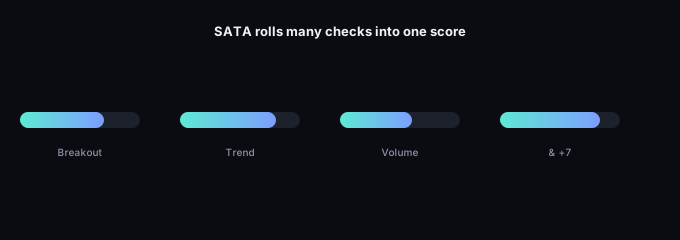
SATA — Stage Analysis Technical Assessment — is a 0-to-10 composite score computed by ATHENA for every symbol. It answers a single question: how strongly do the technical indicators confirm the current stage classification?
A high SATA score does not mean a stock will go up. It means the technical picture is internally consistent with a bullish stage reading. A Stage 2 stock at SATA 9 has broad indicator confirmation. A Stage 2 stock at SATA 3 has a tentative stage label with weak technical support—very different risk profiles.
SATA is one layer in a multi-step research process. Use it alongside stage analysis, Mansfield RS, and the trading signal.
How the score is built: the ten components
SATA is computed as a sum of ten binary or continuous components, normalized to a 0–10 scale. Each component captures a different dimension of technical health.
Component 1 — Price vs 10-day moving average
What it measures: Is the stock currently trading above its 10-day simple moving average?
The 10-day MA is the shortest period tracked. A price above this level indicates near-term momentum is positive. Scores 1 point when true.
Component 2 — Price vs 20-day moving average
What it measures: Is the stock above its 20-day SMA?
The 20-day MA smooths out daily noise while still reacting to recent trends. Stocks above their 20-day are generally in an intermediate uptrend. Scores 1 point when true.
Component 3 — Price vs 50-day moving average
What it measures: Is the stock above its 50-day SMA?
The 50-day MA is a widely-watched medium-term trend marker. Institutional desks often use it as a filter for position initiation. Scores 1 point when true.
Component 4 — Price vs 200-day moving average
What it measures: Is the stock above its 200-day SMA?
The 200-day MA is the foundational long-term trend line in Weinstein’s methodology. Being above it is a prerequisite for true Stage 2 status in the classical framework. Scores 1 point when true.
Together, components 1–4 create a “stack”—4/4 means aligned uptrend across all timeframes; 0/4 means the stock is below all major moving averages.
Component 5 — Mansfield Relative Strength
What it measures: Is the stock outperforming the S&P 500 benchmark (SPY) on a normalized basis?
This is the binary version of the Mansfield RS metric. When positive, the stock is generating better returns than the market index on a relative basis. Scores 1 point when Mansfield RS > 0.
See Relative strength and Mansfield RS for a full explanation of how this is calculated.
Component 6 — RSI momentum gate
What it measures: Is the 14-period RSI above 50?
RSI above 50 indicates that average gains over the lookback period are outpacing average losses—a momentum-positive signal. This is distinct from the overbought (>70) or oversold (<30) interpretation most commonly associated with RSI. Here it functions as a directional filter. Scores 1 point when RSI > 50.
Component 7 — Rate-of-change momentum
What it measures: Is the 10-day price rate-of-change (ROC) positive?
ROC measures how much the stock has moved over the past 10 trading days expressed as a percentage. A positive reading confirms that recent price change is directionally constructive. Scores 1 point when 10-day ROC > 0.
Components 6 and 7 together create a two-part momentum check. Both firing = strong near-term upward momentum.
Component 8 — Volume confirmation (continuous)
What it measures: How does recent volume compare to its baseline?
Unlike the binary components above, the volume score is a normalized continuous value between 0 and 1. It rewards stocks where recent trading volume is elevated relative to its own history—evidence of institutional participation, not just retail interest. Scores up to 1 point based on normalized volume levels.
Component 9 — Overhead resistance proximity
What it measures: How far is the stock from its 52-week and 26-week highs?
Overhead resistance—old price levels where sellers previously entered—creates friction for advancing stocks. A stock trading well below its 52-week high faces more overhead supply. This component scores higher when the stock is closer to or above those prior highs, meaning supply has been absorbed. Scores up to 1 point based on proximity to historical resistance levels.
Component 10 — Breakout detection
What it measures: Is the stock breaking out to a new 20-day high with volume confirmation?
A 20-day high breakout on elevated volume is a classic entry signal in stage-based investing. This component checks for both conditions simultaneously. Scores 1 point when both the price threshold and volume confirmation are present.
Score ranges and interpretation
| SATA Score | Description | What it suggests |
|---|---|---|
| 0 – 3 | Weak | Few or no technical components are confirming. Even if the stage label is positive, the signal quality is low. |
| 4 – 6 | Developing | Mixed confirmation. Some positives exist but the picture is incomplete. Worth monitoring but not a strong entry signal. |
| 7 – 8 | Strong | Most components agree. The technical setup is healthy and consistent with the stage classification. |
| 9 – 10 | Very strong | Near-unanimous confirmation across all indicators. Rare; typically seen in strong trending stocks with volume and momentum aligned. |
A score of 9–10 is uncommon. When you see it, verify that the stock hasn’t already made a large move—extreme SATA readings sometimes appear after, not before, a significant price advance.
The stage × SATA matrix
Stage and SATA together give you a more complete picture than either alone:
| SATA 0–3 | SATA 4–6 | SATA 7–10 | |
|---|---|---|---|
| Stage 1 | Weak base, no signals | Building base, watch | Unusual; could be near a breakout |
| Stage 2 | Stage label present but unconfirmed | Moderate confirmation; worth watching | Strong technical setup; typical BUY territory |
| Stage 3 | Weakening; deteriorating breadth | Mixed signals at top | High SATA in Stage 3 may signal final blow-off; extreme caution |
| Stage 4 | Confirmed decline | Bounce attempt, not a reversal | Very rare; could be an oversold technical recovery, not a trend change |
The most actionable combinations are Stage 2 + SATA 7–10 (bullish) and Stage 3/4 + falling SATA (defensive).
SATA as a quality filter for signals
TRINITY’s signal engine uses SATA thresholds as gates. A BUY signal requires not just a favorable stage but a minimum SATA score to confirm the setup isn’t built on weak foundations. This is why two stocks in Stage 2 may receive different signals—their SATA scores differ.
When a signal is accompanied by low SATA, treat it with extra skepticism. The model is seeing a stage classification that the broader indicator set does not fully support.
What SATA cannot tell you
- It does not predict price targets. SATA confirms the technical setup; it does not project how far a stock will move.
- It can lag. Component 4 (200-day MA) and component 9 (overhead resistance) change slowly. A stock that just broke out may still show a moderate SATA while the longer-horizon components catch up.
- It doesn’t account for fundamentals. A stock can have SATA 10 and also have a collapsing business model. Technical confirmation and fundamental health are separate dimensions.
- High SATA in a bear market is riskier. If the overall market is in Stage 4, even technically strong individual stocks face headwinds. Always read SATA in the context of market conditions.
SATA scores are model outputs subject to change as new market data is processed. Scores do not constitute investment advice and do not guarantee future performance. See Disclosures.
Progress is saved in this browser. Cloud sync requires PUBLIC_IRIS_API_BASE, IRIS CORS allowlist,
and window.__trinityIdToken.