Reading trading signals
What TRINITY's five signal types mean, how they're generated, and how to use them responsibly as one input in your investment process.
The five signals
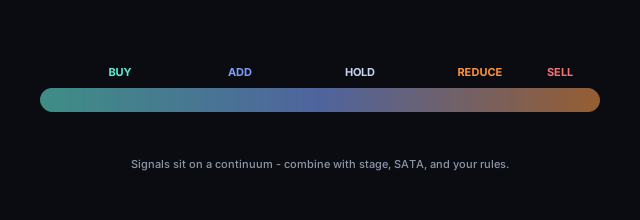
Every symbol analyzed by ATHENA receives one of five signal recommendations. On symbol pages IRIS often shows this as AI Signal—the same five outcomes below. Each signal reflects the combination of stage classification, technical indicator confirmation, and model confidence:
| Signal | Short meaning |
|---|---|
| BUY | The setup meets the criteria for a new long entry |
| ADD | An existing position in this stock is in a favorable stage to add to |
| HOLD | Stage is acceptable but entry criteria are not fully met; maintain existing positions and wait |
| REDUCE | Conditions are weakening; consider trimming an existing position |
| SELL | Stage and indicators warrant exiting a long position |
These signals are research inputs, not instructions. They reflect what the model sees at a point in time. Your risk tolerance, portfolio context, tax situation, and own research must all inform any actual trade decision.
How signals are generated
ATHENA uses a layered logic: stage is the first gate, then indicators add confirmation, then confidence is assessed.
BUY signal
A BUY signal is generated when all of the following conditions are met:
- Stage 2 classification — The stock is in an uptrend phase (Stage 2A or 2B)
- MACD confirmation — The MACD line is above the signal line (bullish momentum crossover)
- Not severely overbought — RSI is not in an extreme overbought range that suggests near-term pullback risk
- Technical quality — SATA score ≥ 7, OR Mansfield RS ≥ 25 provides strong additional confirmation
When all gates pass, the signal is generated as BUY with HIGH confidence. If the stage is right but some confirming indicators are borderline, the signal may be BUY with MODERATE confidence. See the confidence section below.
ADD signal
An ADD signal indicates that the stock is already in an established Stage 2B (the more mature, sustained uptrend phase) and new strength is emerging:
- The stage is confirmed and the trend is proven (not a fresh breakout)
- A new technical trigger appears—a fresh MACD crossover, a volume surge, or a breakout from a minor consolidation within the uptrend
- SATA and Mansfield RS continue to confirm
ADD signals are appropriate for positions you already hold, not necessarily for initiating fresh positions. The logic is: the thesis is validated; this is an opportunity to increase exposure.
HOLD signal
HOLD means the overall picture is not unfavorable, but the entry criteria for a full BUY are not met:
- Stage is Stage 2 but confirmation is mixed (SATA 4–6, or Mansfield RS slightly negative)
- Stage is late Stage 1 approaching a potential breakout, but hasn’t triggered yet
- The stock recently triggered a BUY but indicators have cooled without showing Stage 3 deterioration
For existing positions: a HOLD signal suggests the thesis is intact but doesn’t warrant adding more. For new positions: HOLD means wait for better confirmation before entering.
REDUCE signal
REDUCE signals appear when the stage and indicators are showing early deterioration:
- Stage is late Stage 2 or early Stage 3 (beginning of distribution)
- RSI is diverging (price making new highs but RSI declining)
- MACD is crossing bearish
- Mansfield RS is declining toward or below zero
- SATA is falling from a previously high reading
REDUCE does not mean “sell everything.” It means the balance of evidence is shifting toward caution. Trimming exposure—reducing a full position to a partial one—is the typical response.
SELL signal
A SELL signal represents the strongest cautionary case:
- Stage 4 classification confirmed (markdown phase)
- Multiple confirming indicators (MACD bearish, price below major MAs, volume on down days)
- SATA score declining or low
- Mansfield RS significantly negative
A SELL signal on a position you don’t hold has no direct meaning. A SELL signal on a position you do hold is a strong prompt to review your exit plan and risk exposure immediately.
Signal confidence levels
Every signal carries a confidence assessment that reflects how strongly the model’s evidence supports the recommendation:
| Confidence | Meaning |
|---|---|
| High | All primary gates passed cleanly; the signal is well-supported across stage, indicators, and ML model output |
| Moderate | The primary stage gate passed but some confirming indicators are mixed; the signal is reasonable but not fully confirmed |
| Low | The stage classification supports the signal direction, but indicator quality is poor or data is sparse |
Practical guidance:
- High confidence signals deserve serious attention but are still not guarantees
- Moderate confidence signals are worth investigating; apply extra scrutiny before acting
- Low confidence signals should generally be set aside until clarity improves; they are research hints, not actionable recommendations
High-confidence BUY signals in unfavorable market conditions should still be viewed cautiously—individual stock signals don’t override the macro environment.
Signal staleness: the data timing question
ATHENA runs batch analysis on a scheduled cadence. The signal shown on a symbol page reflects the most recent completed analysis run, not a live real-time calculation.
In a fast-moving market, a price that has moved significantly since the last batch run may mean the displayed signal no longer reflects the current state. Always note:
- When the last analysis was run (check the timestamp on the symbol page)
- Whether recent price action has materially changed the technical picture since that run
If a stock has moved 10% since the last batch analysis, a BUY signal from that run deserves fresh scrutiny. The indicators driving that signal were computed before the move.
The most important principle: one input among many
Signals are designed to surface opportunities and prompt research, not to replace judgment. The most common mistake is treating every BUY signal as an instruction to immediately buy.
Before acting on any signal, ask yourself:
- Do I understand why this signal was generated? (Which stage? What SATA? What’s the RS reading?)
- Have I looked at the actual price chart and recent price action?
- Does this position fit within my portfolio’s sector diversification and position size limits?
- What is my exit plan if the thesis is wrong?
- Has the signal data aged significantly since the last batch run?
A BUY signal with a well-considered “no” on any of these questions is a signal you should pass on.
Common misuses of signals
Treating signals as buy/sell orders. Signals are analytical outputs. Execution decisions—price, size, timing, account, tax consequences—are entirely yours.
Ignoring market context. A high-confidence BUY in a stock during a broad Stage 4 market environment faces headwinds that the individual signal doesn’t capture. Always layer in market condition awareness.
Acting on signals alone without reading the stage. If you see BUY but the stock is technically in a fragile Stage 2A with SATA 5, the signal is lower quality than BUY alone suggests. Read the full picture through stage analysis and the SATA score.
Chasing signals after large moves. A BUY generated on Monday looks different if the stock gapped up 8% at Tuesday’s open. Signal staleness is real; fresh analysis matters.
Ignoring REDUCE and SELL signals on held positions. These signals exist to prompt discipline on the exit side. Loss aversion is a well-documented behavioral bias. When ATHENA signals Stage 3 deterioration on a held position, that is exactly the moment to re-examine the thesis—not to rationalize holding.
Connecting signals to action in TRINITY
Signals feed directly into several TRINITY workflows:
- Hunt — Uses signal data to surface portfolio improvement candidates. A REDUCE signal on a held position may appear as a Hunt suggestion to trim. See Hunt, Cash Hunt, and optimization.
- ARES automated trading — If you have automation enabled, ARES may use signal logic as one of its inputs. Signal thresholds for automated execution are governed by your portfolio settings and the safeguards you have configured. See Automated trading with TRINITY.
- Watchlist monitoring — Signals update as batch analysis runs, allowing your watchlist to surface when monitored symbols move from HOLD to BUY or from ADD to REDUCE.
All signals are model outputs generated from historical market data. They do not constitute investment advice and do not guarantee any particular outcome. Signal reasoning reflects conditions at the time of the most recent analysis run. Market conditions change; always verify current data before acting. See Disclosures.
Progress is saved in this browser. Cloud sync requires PUBLIC_IRIS_API_BASE, IRIS CORS allowlist,
and window.__trinityIdToken.