Understanding market conditions
How the broad market environment affects individual stock analysis in TRINITY—and why the same stock can warrant different responses in different regimes.
Why individual analysis isn’t enough
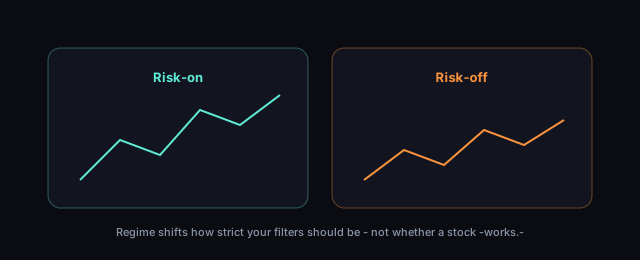
TRINITY’s ATHENA engine analyzes every stock on its own merits—stage, SATA, Mansfield RS, indicators, signals. But no stock exists in isolation. The broad market environment exerts enormous influence on whether a given setup actually plays out.
A Stage 2 stock with SATA 9 and a BUY signal in a bull market behaves differently from the exact same technical setup in a bear market. Understanding market conditions helps you calibrate how much confidence to place in individual signals—and when to apply tighter filters across your entire portfolio.
What “market regime” means
A market regime describes the broad environment in which individual stocks are operating. Three primary regimes are commonly referenced:
| Regime | Characteristics | Implication for stock selection |
|---|---|---|
| Bull | SPY in Stage 2, breadth improving, most sectors advancing | Individual BUY signals carry more weight; a rising tide lifts many Stage 2 boats |
| Neutral | SPY in Stage 1 or choppy Stage 2, mixed breadth | Be more selective; prefer higher SATA and stronger Mansfield RS; reduce position sizes |
| Bear | SPY in Stage 3 or Stage 4, breadth deteriorating, most sectors declining | Individual BUY signals are higher risk; favor defensive postures; cash is a valid position |
TRINITY’s stage analysis logic applies to the SPY ETF itself, giving you a consistent framework for reading the broad market using the same tools you use for individual stocks. If SPY is in Stage 4, that is a significant piece of context even for stocks that individually show Stage 2.
SPY as the anchor for Mansfield RS
Every Mansfield RS value computed by ATHENA is measured relative to SPY. This creates an important link between individual stock analysis and the broad market:
- When SPY is advancing strongly, it becomes harder for individual stocks to show positive Mansfield RS. Only the true leaders will outperform a powerful benchmark.
- When SPY is declining, many stocks will show negative Mansfield RS by default. The stocks maintaining positive RS in this environment are displaying genuine resilience—exactly what Weinstein’s framework identifies as the highest-quality Stage 1 bases to watch.
Reading Mansfield RS values always requires knowing what SPY is doing. An RS of +5 in a bear market is more impressive than an RS of +30 in a bull market where everything is rising.
Reading aggregate stage distribution
One of the most practical ways to assess the market regime within TRINITY is to look at the aggregate stage distribution across the universe of analyzed symbols:
| Distribution pattern | What it suggests |
|---|---|
| Majority in Stage 2 | Broad bull market; conditions favor active long exposure |
| Mixed Stage 1 and 2 with some Stage 3 | Maturing bull; be selective; trim overextended positions |
| Growing Stage 3 / Stage 4 concentration | Late cycle; reduce exposure; apply tighter entry criteria |
| Majority in Stage 4 | Bear market; defensive posture; cash and short-term instruments worth considering |
| Stage 1 starting to emerge from Stage 4 | Potential early recovery; watch for leading sectors |
This distribution is a macro-level reading, not a precise timing tool. Stage transitions are gradual, not sudden—by the time the majority of stocks are in Stage 4, many of the losses in the typical portfolio have already occurred. Use the distribution trend (are Stage 4 names increasing week-over-week?) as much as the snapshot.
Sector and industry conditions
Market conditions don’t affect all sectors equally. A bear market in the broad index can coincide with a bull market in defensive sectors (utilities, consumer staples, healthcare). A bull market in the broad index can coexist with a Stage 4 environment in sectors hit by structural disruption (legacy energy, certain retail sub-industries).
When evaluating any individual stock’s stage and signal:
- What stage is the broad market (SPY) in?
- What stage is the sector ETF for this stock in?
- What stage is the individual stock in?
Alignment across all three levels—stock, sector, and market—is the highest-conviction setup. Misalignment is a reason to reduce position size or wait for confirmation.
When to apply tighter filters
Market conditions should directly influence how strict you are when evaluating individual signals. A useful heuristic:
Bull regime: You can act on SATA 7+ with moderate Mansfield RS. The market is providing a tailwind.
Neutral regime: Raise your bar to SATA 8+ and require positive Mansfield RS. Only take signals where multiple layers confirm.
Bear regime: Require SATA 9–10 and strong positive Mansfield RS before considering any long. Reduce position sizes. Consider cash as a default. HOLD, REDUCE, and SELL signals take on greater weight.
This is not a rigid rule—it’s a framework for thinking about how much the market environment is working with you or against you.
Dynamic calibration: how ATHENA adapts
ATHENA’s signal thresholds and model weighting are not static. ATHENA applies dynamic calibration to account for shifting market conditions over time:
- Threshold adjustment: The minimum SATA and RS values required to generate signals can be recalibrated based on the current distribution of indicator readings across the universe.
- Model retraining: The underlying Random Forest classifier is periodically retrained on fresh historical data. Markets evolve; a model trained only on one era of market behavior can become stale.
- Confidence adjustment: In high-volatility regimes, model confidence scores are typically lower across the board—reflecting genuine uncertainty in the data, not model failure.
Dynamic calibration means that the same raw SATA score of 7 in January may imply a stronger or weaker setup than the same score in July, depending on what the overall distribution of scores looks like across the universe. TRINITY normalizes for this so that a “strong” signal is consistently strong relative to current conditions.
Market conditions vs individual stock analysis: both matter
The most important principle: individual stock analysis and market condition awareness are not alternatives—they’re layers.
- Great individual setups fail in bear markets. Market regime is not an excuse to ignore individual analysis.
- Terrible individual setups occasionally work in roaring bull markets. Regime tailwinds are not an excuse to ignore stock quality.
The highest-quality trade setups align at every level: stock in Stage 2 with strong SATA and positive RS, sector in Stage 2, and broad market in Stage 2 or healthy Stage 1 emerging. When all three layers agree, the weight of evidence is on your side—not a guarantee, but a meaningful edge.
When they don’t agree, that’s information too. Misalignment tells you to be smaller, more patient, or to look elsewhere.
Connecting to portfolio management
Market condition awareness feeds directly into how you manage your portfolio in TRINITY:
- Position sizing: Smaller average positions in neutral and bear regimes, larger in confirmed bull regimes.
- Cash allocation: Cash is not idle—it’s a risk-management tool. Holding higher cash in Stage 3/4 markets is a deliberate strategy, not paralysis.
- Hunt and optimization: TRINITY’s Hunt engine and DIONYSUS optimization factor in portfolio-level context. If you have configured conservative settings, these tools should surface fewer and more selective opportunities in deteriorating market conditions. See Hunt, Cash Hunt, and optimization.
- Portfolio basics: For foundational concepts on building and managing a portfolio in TRINITY, see Portfolio basics.
Market regime assessments are interpretations of model outputs and should not be treated as definitive predictions. Market environments can shift rapidly and without warning. This content is educational and does not constitute investment advice. See Disclosures.
Progress is saved in this browser. Cloud sync requires PUBLIC_IRIS_API_BASE, IRIS CORS allowlist,
and window.__trinityIdToken.