Understanding stage analysis
A retail investor's guide to the four-stage cycle—how TRINITY classifies every stock and what each stage means for your research.
What stage analysis is—and why it matters
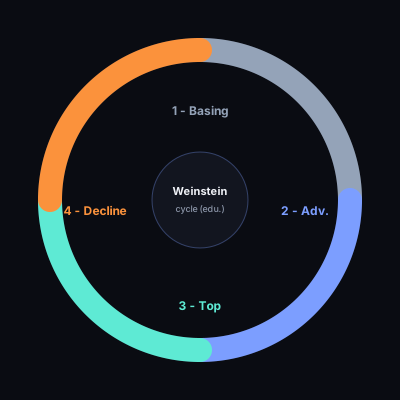
Every stock moves through a repeating cycle of price behavior. Stan Weinstein codified this in his 1988 book Secrets for Profiting in Bull and Bear Markets, describing four distinct phases a stock passes through as institutions accumulate, ride, distribute, and exit positions. TRINITY’s ATHENA engine applies this framework automatically across thousands of symbols every trading day.
The investing edge: if you can identify where a stock sits in its cycle, you can make more informed decisions about when to get involved and when to step aside—regardless of how compelling the story sounds.
Stage analysis is one input. It does not guarantee outcomes. Markets are complex, and even well-classified Stage 2 stocks can fail. Use stage labels alongside your own research and risk management.
The four stages: a reference guide
| Stage | Name | Market behavior | Volume pattern | Typical posture |
|---|---|---|---|---|
| Stage 1 | Accumulation (Base) | Price moves sideways after a decline; institutions quietly absorb supply | Volume contracts; occasional spikes on up days | Neutral—watch, don’t commit |
| Stage 2 | Markup (Advance) | Price breaks above the base and trends upward; institutions now driving the move | Rising volume on up days; lower volume on pullbacks | Favorable for long positions |
| Stage 3 | Distribution (Top) | Price stalls near highs; institutions begin offloading to retail buyers | Irregular, often heavy volume; choppy price action | Caution—trim or prepare to exit |
| Stage 4 | Markdown (Decline) | Price breaks down below prior support; institutional selling accelerates | Volume often spikes on down days | Unfavorable—avoid or exit |
The cycle then repeats. A Stage 4 stock eventually stabilizes into a new Stage 1 base, sometimes months or years later.
Sub-stages in TRINITY
ATHENA uses finer-grained labels beyond the four main stages:
- Stage 1A — Early accumulation; price still weak but stabilizing. Overhead supply is heavy.
- Stage 2A — Early markup; the breakout is fresh, volume confirming, but the move is unproven.
- Stage 2B — Established markup; the trend is sustained, pullbacks are shallow, and momentum is strong. This is the “sweet spot” most stage-analysis frameworks target.
- Stage 3A — Early distribution; price still near highs, but breadth and volume patterns are deteriorating.
Not every symbol will progress through every sub-stage. Some jump directly from a brief Stage 1 to a sharp Stage 2; others linger in Stage 3 before dropping. Sub-stage labels help you track where in the arc the current move sits.
Stage confidence
Each stage classification carries a confidence score—a normalized probability that reflects how strongly ATHENA’s model and rules agree on the current classification. Confidence is not a prediction of price performance.
| Confidence | Meaning |
|---|---|
| High | The model and indicator signals strongly agree. Classification is stable. |
| Moderate | Signals are mixed; the stage label reflects the best available reading but may change with new data. |
| Low | Signals are conflicting or data is sparse. Treat the label with extra skepticism. |
Low-confidence labels are normal during earnings, major news events, and periods of unusually high volatility. In those situations, wait for clarity rather than acting on the label.
Where stages appear in TRINITY
Stage labels surface across the product to help you act on analysis without switching between tools:
- Symbol pages — The primary stage label and confidence are shown prominently alongside price, indicators, and the signal recommendation. See Analysis, batch jobs, and symbol pages.
- Screeners and watchlists — Filter your universe by stage to focus on the cycle phase you’re targeting. Sorting by SATA score within a stage filter is a common workflow—see The SATA score.
- Hunt — TRINITY’s portfolio-improvement engine uses stage context when evaluating which symbols to surface as candidates. A symbol in Stage 4 will generally not appear as a Hunt recommendation for a growth-oriented portfolio.
- Signal reasoning — The trading signal shown on each symbol explicitly references the stage as the primary gate for BUY and SELL logic.
- Batch analysis — When you run analysis across many symbols, results include stage labels for each, making it easy to sort and filter at scale.
What stage analysis does NOT tell you
Stage labels are powerful but deliberately limited:
- Not a price target. Stage analysis tells you direction and phase, not how far a move will travel or when it will end.
- Not immune to news. An earnings miss or macro shock can compress or skip stages overnight. The model updates as new data arrives, but cannot predict events before they happen.
- Not a sector filter. A Stage 2 stock in a declining sector is riskier than the same stage in a favorable sector. Always consider market conditions.
- Not guaranteed to be current. ATHENA runs batch analysis on a scheduled cadence. The stage shown reflects the most recent completed run. In fast-moving markets, fresh price data may not yet be reflected.
- Not personalized advice. Stage labels are informational and educational. They do not account for your tax situation, risk tolerance, time horizon, or financial goals.
Connecting the concepts
Stage analysis works best as the outermost filter in a research process. The typical flow used by TRINITY’s tools:
- Stage filter — Start with stocks in Stage 2 (or late Stage 1 approaching breakout)
- SATA score — Confirm technical quality (The SATA score)
- Mansfield RS — Confirm market outperformance (Relative strength and Mansfield RS)
- Signal check — Review the BUY/HOLD/REDUCE/SELL signal and its confidence (Reading trading signals)
- Market context — Check whether the broad environment favors this kind of exposure (Understanding market conditions)
Each layer adds confirmation. No single layer is sufficient on its own.
For pattern lists, pattern direction, transition probability percentages, and key level panels on symbol pages, see Patterns and structure on the symbol page and Stage transition probabilities. For engine scope, see How ATHENA fits your trading process.
Further reading
- Analysis, batch jobs, and symbol pages — full symbol-page hub
- Market cycles and stages — overview of the four stages
- Patterns and structure on the symbol page
- Stage transition probabilities
- How ATHENA fits your trading process
All stage labels are model outputs and may be incorrect or delayed. Past cycle behavior does not guarantee future performance. This content is educational—not personalized investment advice. See Disclosures.
Progress is saved in this browser. Cloud sync requires PUBLIC_IRIS_API_BASE, IRIS CORS allowlist,
and window.__trinityIdToken.