Stage transition probabilities
How to read the Stage Transition Probabilities panel on symbol pages—what the percentages mean, what they omit, and how to use them with signals and timestamps.
What the panel is
On /symbol/<SYMBOL>, when ATHENA supplies transition probabilities, IRIS shows a Stage Transition Probabilities card (often with a chart). The in-app tooltip describes these as the statistical likelihood of moving from the current cycle stage to another stage in the near term.
This guide explains how to interpret that language responsibly—alongside Understanding stage analysis, Reading trading signals, and Analysis, batch jobs, and symbol pages.
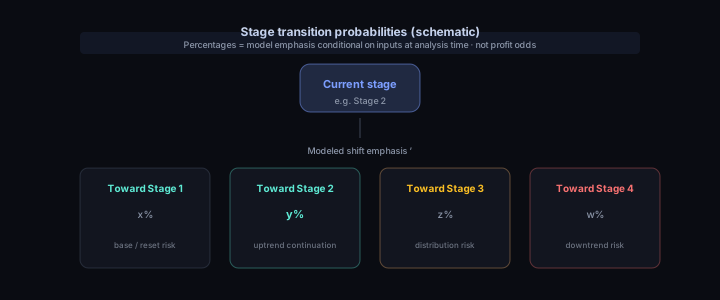
What the percentages are (and are not)
They are:
- Model summaries derived from ATHENA’s feature set (price history, indicators, regime context, and related inputs).
- A way to see relative emphasis—for example, more weight on a move toward Stage 2 vs Stage 4 as of the analysis run.
They are not:
- A promise that the stock will enter a given stage on a schedule.
- A substitute for earnings, news, liquidity, or your max loss per trade.
- A probability of profit—same rule as stage confidence: high numbers describe internal consistency and statistical weighting, not how much money you will make.
How to read them alongside your current stage
- Confirm the stage you see on the symbol page (1–4 and sub-stage language when shown).
- Scan transitions that point toward healthier vs weaker parts of the cycle—for example, mass toward Stage 2 often aligns with constructive trend continuation hypotheses; mass toward Stage 4 aligns with defensive caution in the Weinstein-style framework.
- Compare to the five-letter signal (Reading trading signals). Signals fold in harder gates (stage, SATA, Mansfield RS). Transitions describe shift potential; they can look “optimistic” while the signal stays HOLD if gates are not all satisfied—or the reverse after a sharp gap.
Staleness and fast markets
Transition probabilities are only as fresh as the analysis timestamp (and related “last updated” fields) on the page.
- After earnings, guidance, offerings, or index rebalances, inputs can change abruptly—probabilities from the prior run may be outdated until the next successful analysis.
- Treat large overnight gaps as a reason to re-fetch context (refresh symbol page, watch for batch completion) before leaning on any single percentage.
See Signal staleness in the Glossary.
When probabilities swing hard
You may notice big shifts in transition readouts when:
- Volatility expands and indicators disagree (whipsaw risk).
- The stock moves from late Stage 1 toward a breakout—or fails a breakout back into Stage 4 language.
- Market regime flips (see Understanding market conditions).
Those are behavioral reminders to slow down and re-check the full card: stage, SATA, RS, pattern context (Patterns and structure), and your portfolio rules.
Further reading
- Market cycles and stages—hub for the four-stage vocabulary
- Patterns and structure on the symbol page—pattern direction vs AI Signal
- How ATHENA fits your trading process—engine scope and blind spots
- FAQ & troubleshooting—common “why did this change?” questions
Educational disclaimer
TRINITY provides tools and education, not personalized investment advice. Transition probabilities are informational. Consult a qualified professional before making financial decisions.
Progress is saved in this browser. Cloud sync requires PUBLIC_IRIS_API_BASE, IRIS CORS allowlist,
and window.__trinityIdToken.