Market cycles and stages (overview)
A complete guide to the four-stage cycle framework used in TRINITY analysis—what each stage means, how transitions work, and how to use stage data responsibly.
Why stages matter in the product
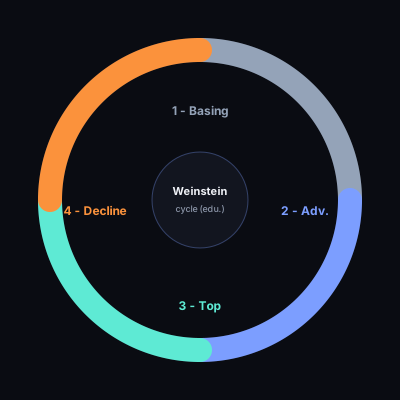
TRINITY’s analysis engine (ATHENA) classifies securities into stage-style labels inspired by classic stage analysis methods developed by Stan Weinstein. These labels summarize model output derived from price action, moving averages, volume, and relative strength. They are not a guarantee of future price movement—they are a systematic description of current technical conditions.
Stage labels appear on symbol pages, in screeners, inside Hunt reasoning, and in signals. They are one analytical lens—not a substitute for earnings quality, balance sheet risk, sector context, or your own investment judgment.
For an in-depth treatment, see Understanding stage analysis. This page provides an overview and navigation hub.
The four stages
Stage 1: Accumulation
After a prolonged decline, price eventually stops making lower lows and enters a base-building phase. Volume often contracts. The stock trades in a range as sellers exhaust themselves and early buyers cautiously accumulate positions.
Technical characteristics:
- Price oscillating roughly around a flattening 200-day SMA
- Trading volume generally declining from peak levels
- Relative strength improving from deeply negative toward neutral
- Bollinger Bands narrowing (volatility compression)
What it means for analysis: Stage 1 stocks are not yet in uptrends. Long entry candidates are Stage 1B stocks (late-stage bases approaching breakout)—but entry here carries more execution risk because Stage 2 has not been confirmed. The framework favors patience.
TRINITY sub-stages: 1A (early basing), 1B (mature base building toward breakout).
Stage 2: Markup (Uptrend)
Price breaks above the Stage 1 base on expanding volume and enters a sustained uptrend. Moving averages are rising and in proper order (shorter above longer). This is the primary stage that TRINITY’s framework targets for long exposure.
Technical characteristics:
- Price above rising 10-day, 50-day, and 200-day SMAs
- Moving averages in bullish alignment (10 > 50 > 200)
- Positive Mansfield RS (stock outperforming SPY)
- SATA score typically 7–10
- BUY or ADD signals from ATHENA
What it means for analysis: Stage 2 is the home of the primary uptrend. The full screening workflow described in A stage-based investing approach is designed to identify high-quality Stage 2 stocks with broad confirmation.
TRINITY sub-stages: 2A (fresh breakout from Stage 1), 2B (established, continuing uptrend).
Stage 3: Distribution
After an advance, price reaches a zone where sellers outweigh buyers and the stock begins distributing to the market. This is the topping process. It can last weeks or months.
Technical characteristics:
- Price action volatile and churning near highs
- Moving averages flattening or beginning to turn down
- Mansfield RS weakening toward zero or turning negative
- Volume often spiky on down days
- REDUCE signals from ATHENA
What it means for analysis: Stage 3 is a warning zone. The framework recommends trimming or preparing to exit positions in Stage 3. Stage 3 can eventually resolve back into Stage 2 (continuation) or break down into Stage 4 (decline)—ATHENA’s confidence score helps indicate which is more likely.
TRINITY sub-stages: 3A (early warning signs), 3B (confirmed distribution).
Stage 4: Markdown (Downtrend)
Price breaks below Stage 3 support and enters a sustained downtrend. Moving averages are falling and in bearish order.
Technical characteristics:
- Price below falling 200-day SMA
- Moving averages in bearish alignment (10 < 50 < 200)
- Negative Mansfield RS (stock underperforming SPY)
- SATA score typically 0–3
- SELL signals from ATHENA
What it means for analysis: Stage 4 stocks are not candidates for long positions in this framework. Holding Stage 4 positions waiting for a “bounce” typically results in catching a falling knife. Stage 4 eventually ends when decline exhausts and a new Stage 1 base begins.
Stage sub-stages and transitions
Stages don’t flip instantaneously—they transition through sub-stages that reflect intermediate conditions:
| Sub-stage | Description |
|---|---|
| 1A | Early base; price still potentially volatile, Stage 1 freshly established |
| 1B | Mature base; price compressed, breakout potentially imminent |
| 2A | Fresh Stage 2 breakout from a Stage 1 base |
| 2B | Established Stage 2 uptrend, multiple tests of moving averages held |
| 3A | Early Stage 3 warning; trend weakening but not confirmed breakdown |
| 3B | Confirmed Stage 3 distribution; breakdown likely or underway |
Stage confidence
Each stage classification includes a confidence score (0–100%). This reflects how internally consistent the model’s inputs are with the assigned stage—how many indicator signals agree with the classification.
High confidence means the model has strong indicator support. Low confidence means mixed signals. Confidence is not a probability of profit and not a guarantee that the stage will persist.
See Understanding stage analysis for how confidence is calculated and interpreted.
Indicators alongside stages
Stage labels don’t stand alone. Alongside them you’ll see:
- SATA score (0–10): technical confirmation quality across ten components. See The SATA score.
- Mansfield RS: relative performance vs. SPY. See Relative strength and Mansfield RS.
- Signal (BUY / ADD / HOLD / REDUCE / SELL): the model’s recommended action. See Reading trading signals.
- Individual indicators (RSI, MACD, SMAs, volume, etc.): see Technical indicators guide.
These are features feeding the model, not standalone buy/sell rules. The stage + SATA + signal combination tells a richer story than any single metric.
Using stages responsibly
Do:
- Use stage + SATA + Mansfield RS + signal together for higher-quality analysis
- Compare stages with fundamentals, liquidity, and your own investment plan
- Treat confidence scores as relative indicators of model certainty, not profit guarantees
- Account for the broad market regime before acting on individual signals
Don’t:
- Automate leverage or margin from stage alone
- Treat a BUY signal as a guarantee of upside
- Hold Stage 4 positions waiting for a “correction to be over”
- Ignore corporate actions or data quality issues that may distort indicators
Stages can repaint
Stages can change or repaint around earnings releases, index rebalances, macro shocks, and major news events. A “markup” (Stage 2) label does not mean drawdowns are impossible. Position sizing, stop discipline, and portfolio diversification remain essential regardless of what stage analysis suggests.
For a complete framework on applying this responsibly, see A stage-based investing approach.
Further reading
- Understanding stage analysis — deep dive into the 4-stage cycle, sub-stages, and limitations
- The SATA score — all ten SATA components explained
- Relative strength and Mansfield RS — why RS matters and how to use it
- Reading trading signals — BUY/ADD/HOLD/REDUCE/SELL logic
- Understanding market conditions — market regimes and how they affect stage analysis
- How TRINITY AI works — the ML model behind stage classification
- A stage-based investing approach — putting it all together
- Technical indicators guide — plain-language indicator reference
- Glossary — term definitions
- Analysis and symbol pages — where stage data surfaces in IRIS
- Patterns and structure on the symbol page — pattern list, pattern direction, levels and targets
- Stage transition probabilities — reading the transition panel
- How ATHENA fits your trading process — what the engine does and does not see
- Allocation strategies — stage-weighted allocation concepts
Progress is saved in this browser. Cloud sync requires PUBLIC_IRIS_API_BASE, IRIS CORS allowlist,
and window.__trinityIdToken.