Patterns and structure on the symbol page
How Pattern Analysis, pattern direction, key levels, and price targets relate to ATHENA—and how they differ from the five trade signals.
Why this guide exists
On /symbol/<SYMBOL>, IRIS shows a Pattern Analysis section plus AI Signal and Pattern Direction in the TRINITY Analysis area. Those panels come from ATHENA’s pattern detection output. They are informational context, not a separate order to buy or sell.
Use this page together with Reading trading signals and Analysis, batch jobs, and symbol pages.
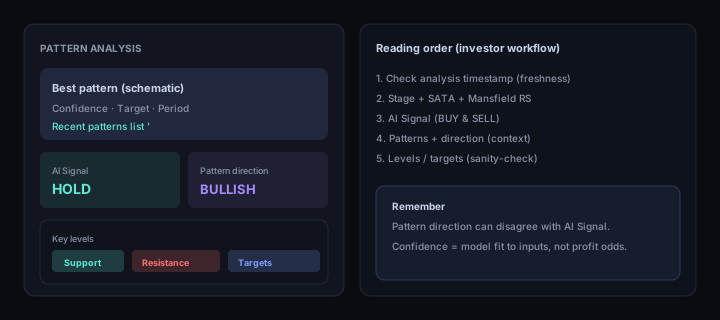
Pattern Analysis card
Detected patterns and “Recent Patterns”
ATHENA may list one or more price formations it recognizes (often shown as a Recent Patterns list). Each entry typically includes:
- A pattern type (a technical label for the formation).
- Status (where the formation sits in its lifecycle—formative, active, completed, and similar states may appear depending on the symbol).
- Confidence, shown as a percentage where available—this reflects how strongly the model associates the price action with that label given its inputs. It is not a probability that the trade will work out.
- Optional price target and date range (start/end) for the pattern window.
Treat the list as a checklist of hypotheses: useful for discussion and journaling, not for bypassing your position size, stops, or fundamentals.
Best Pattern highlight
IRIS often elevates one formation as Best Pattern (sometimes favoring a recent best pattern when that is more relevant). That highlight is the model’s current top pick among listed patterns—still one input among many, alongside stage, SATA, and your five-letter signal.
Pattern Direction vs AI Signal
In the TRINITY Analysis strip you may see:
| Label in IRIS | Meaning |
|---|---|
| AI Signal | One of BUY, ADD, HOLD, REDUCE, SELL—the integrated recommendation described in Reading trading signals. |
| Pattern Direction | A pattern-only readout such as BULLISH, STRONGLY BULLISH, BEARISH, or N/A when pattern work is still pending. IRIS may describe this as positive pattern formation, exceptional bullish strength, bearish pattern detected, or pattern analysis pending. |
They can disagree. For example, the stage-and-indicator stack might justify HOLD while patterns still look BULLISH, or the opposite. That is expected: signals fold in stage gates, SATA, Mansfield RS, and confidence; pattern direction summarizes formation tilt only.
Rule of thumb: Use AI Signal as the primary ATHENA recommendation field. Use Pattern Direction and the Pattern Analysis card to qualify or question that readout—not to replace portfolio rules or risk management.
Key Levels: support and resistance
When shown, Support Levels and Resistance Levels are price zones ATHENA highlights from the same analysis run. Support is shorthand for demand-heavy areas below price; resistance for supply-heavy areas above. Levels may include a strength tag when the product exposes it.
Caveats investors should internalize:
- Levels are model-derived summaries. They can be wrong, stale after a gap, or distorted by corporate actions and bad prints—see Analysis, batch jobs, and symbol pages on data quality.
- Prices bouncing or stalling near a level do not prove the label is “correct”; they only show interaction worth watching.
Price Targets
The Price Targets module shows one or more projected prices with a type (for example pattern-based or model-labeled categories) and sometimes a confidence percentage per target.
Targets are scenario outputs, not promises. Prefer to treat them as planning anchors: where you might scale out, re-evaluate, or tighten stops—always alongside your own rules and the analysis timestamp.
Volatility and sector (context panels)
The same analysis region may show historical volatility and sector. These add environment context for position sizing and expectations; they do not replace reading Understanding market conditions and your watchlist process.
Further reading
- Stage transition probabilities—how the stage transition panel relates to patterns and signals
- Understanding stage analysis—the four-stage framework behind much of the logic
- The SATA score and Relative strength and Mansfield RS—confirmation alongside patterns
- How TRINITY AI works—model and outputs at a high level
- How ATHENA fits your trading process—scope and limits of the engine
Educational disclaimer
TRINITY provides tools and education, not personalized investment advice. Patterns, levels, and targets are informational. Consult a qualified professional before making financial decisions.
Progress is saved in this browser. Cloud sync requires PUBLIC_IRIS_API_BASE, IRIS CORS allowlist,
and window.__trinityIdToken.