How TRINITY's AI works
A plain-language explanation of the machine learning model behind ATHENA's stage analysis—what it learned, how it reasons, and where its limits are.
TL;DR — read this first
- ATHENA labels stages and signals from price and volume history (plus derived indicators)—not from news or fundamentals.
- The AI Signal is a rules-plus-model blend; Pattern Direction and other panels can disagree by design—always check timestamps and When panels disagree.
- Confidence measures internal consistency of the model with its inputs, not odds of profit.
- Downstream tools (Hunt, optimization, automation) use ATHENA outputs at the time they run—see How ATHENA fits your trading process.
- For deeper ML detail (random forests, feature lists), continue below; you can stop after this box if you only need behavior, not implementation.
Why AI for stock analysis?
Identifying market stages from price and volume data is a pattern-recognition problem. Human analysts can look at a chart and intuit “this looks like a Stage 2 breakout”—but applying that judgment consistently across thousands of stocks every day, without fatigue or bias, is where machine learning provides value.
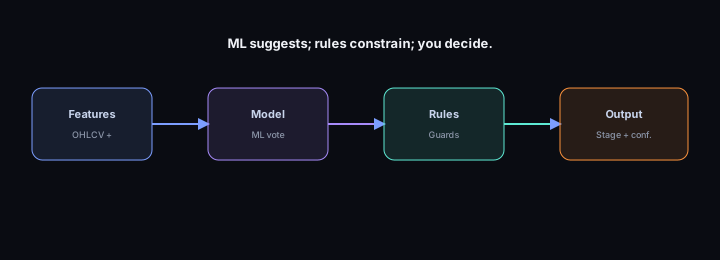
TRINITY’s ATHENA engine uses a machine learning model—combined with explicit rules-based heuristics—to classify each stock into a market stage and generate a signal. Neither the AI alone nor rules alone would be as robust as the combination.
This document explains how that works in terms that don’t require a data science background.
What you see in IRIS (ATHENA outputs)
When you open a symbol page, ATHENA results typically feed these investor-facing elements—each is described in more detail in the linked guides:
| What you see | Plain meaning |
|---|---|
| Stage (1–4, with sub-stage language when shown) | Model + rules placing the stock in the Weinstein-style cycle—see Understanding stage analysis. |
| SATA and Mansfield RS | Technical confirmation and 52-week relative performance vs SPY—see The SATA score and Relative strength and Mansfield RS. |
| AI Signal (BUY, ADD, HOLD, REDUCE, SELL) | Integrated recommendation after gates—see Reading trading signals. |
| Pattern Analysis and Pattern Direction | Detected formations and pattern tilt—may differ from the five-letter signal—see Patterns and structure. |
| Stage Transition Probabilities | Model emphasis on near-term stage shifts—not a profit forecast—see Stage transition probabilities. |
| Key levels, price targets, volatility, sector | Structure and context from the same analysis run—see Patterns and structure and Analysis, batch jobs, and symbol pages. |
| Timestamps | Freshness of the run—always check before acting. |
For scope (what ATHENA does not know), see How ATHENA fits your trading process.
Limitations & fairness (at a glance)
- No fundamentals or news in the model — ATHENA’s inputs are price, volume, and derived indicators. It does not read earnings calls, filings, or headlines; treat those in your own research stack.
- Markets are non-stationary — Relationships between indicators and stages shift over time. Retraining and calibration keep outputs grounded in recent history but cannot guarantee the future matches the past.
- Ensemble + rules, not one simple score — A stage label, SATA, AI signal, and pattern read can diverge because different parts of the pipeline answer different questions. When in doubt, use When panels disagree and check timestamps.
The model in plain language: imagine 500 experts voting
The core algorithm is a Random Forest classifier. Here’s an intuitive way to think about it:
Imagine you had 500 different investment analysts. Each analyst was trained on a slightly different slice of historical stock data and has slightly different views about which price patterns correspond to which market stages. When you show any of them a stock’s indicator readings, each analyst gives you their best guess: “Stage 1,” “Stage 2,” “Stage 3,” or “Stage 4.”
A random forest takes all 500 votes and picks the majority. If 380 out of 500 analysts vote Stage 2, the model says Stage 2 with high confidence. If only 260 vote Stage 2 and 220 vote Stage 3, the classification is Stage 2 with moderate confidence—and you should treat it accordingly.
This voting mechanism is what makes random forests robust. Individual “analysts” (called decision trees) can be wrong; the collective tends to be more accurate than any single tree.
What the model learned
The ATHENA model was trained on labeled historical market data—thousands of stocks across years of market history, each with their indicator readings at each point in time and a corresponding stage label (derived from Weinstein’s framework applied to the historical price structure).
During training, the model found patterns: configurations of RSI, MACD, price vs moving averages, volume, Mansfield RS, and other indicators that historically corresponded to each stage. It learned these correlations from data—not from rules that a human wrote.
The result: a model that can evaluate a new stock’s current indicator readings and estimate the most likely stage based on what similar indicator configurations looked like historically.
The feature vector: what the model sees
When ATHENA analyzes a stock, it assembles a feature vector—a structured list of numerical inputs—from that stock’s current indicator readings. The model then processes this vector to produce its stage classification.
The feature vector includes 20+ indicators:
- Moving average relationships: Price vs 10/20/50/200-day SMAs; 50-day vs 200-day cross status
- Momentum indicators: RSI, MACD, MACD histogram, stochastic %K and %D
- Volatility measures: Bollinger Band width, ATR
- Volume analysis: OBV trend, volume ratio to recent average
- Relative performance: Mansfield RS vs SPY
- SATA sub-scores: The individual components of the SATA composite
- Trend strength: ADX
- Rate-of-change: 10-day and 20-day price momentum
- Risk metrics: Rolling Sharpe ratio, Sortino ratio, drawdown from recent high
Each of these becomes a number that the random forest evaluates. The model doesn’t “see” a chart—it sees a row of numbers representing the current state of all these indicators simultaneously.
Rules-based heuristics: the safety rails
Machine learning models can be overconfident or produce results that violate basic common sense. To guard against this, ATHENA uses explicit rules-based heuristics that override or modify the model’s output when specific conditions are met:
- Minimum SATA thresholds: A model output of Stage 2 is downgraded or held back from a BUY signal if the SATA score is too low. The model might say Stage 2; the rules say “but the technical confirmation isn’t there.”
- Stage consistency checks: The model’s stage prediction is cross-checked against fundamental price structure (is the stock above or below its 200-day MA?). Gross inconsistencies trigger a confidence reduction.
- Confidence floors: If the model’s voting margin is too narrow (e.g., 220 out of 500 trees vote Stage 2, with 200 voting Stage 3), the output is flagged as low confidence regardless of the majority label.
- Data quality checks: If the indicator data is sparse, stale, or anomalous (e.g., due to a corporate action), the model’s output may be suppressed in favor of a “data unavailable” or “low confidence” flag.
The combination of ML + rules is deliberately conservative: the model must be confident, and the heuristics must not veto the output, before a high-confidence signal is issued.
Why ML + rules beats either alone
| ML only | Rules only | ML + rules (TRINITY) | |
|---|---|---|---|
| Adaptability | High—learns from new data | Low—rules are fixed | High |
| Interpretability | Low—hard to explain individual decisions | High—you can read the rules | Medium |
| Resistance to edge cases | Low—can produce surprising results | High—rules handle known failure modes | High |
| Consistency at scale | High | High | High |
| Performance on complex patterns | High | Medium—rules miss subtle configurations | High |
The rules provide guardrails where the model is known to be unreliable. The model captures patterns that explicit rules would never anticipate.
Model confidence: a probability, not a certainty
When the random forest votes, it also produces a probability score—the fraction of trees that voted for the winning class. This probability is the foundation of the confidence levels you see in TRINITY:
- High confidence: Model probability is high (most trees agree); heuristics confirm.
- Moderate confidence: Model probability is meaningful but not dominant; or the model is confident but a heuristic is partially triggered.
- Low confidence: Model probability is low (close vote among trees); or data quality issues are present.
A high-confidence model output is more likely to reflect genuine pattern recognition and less likely to be random noise. But it is never a guarantee—it is a probability estimate based on historical patterns, applied to a future that is inherently uncertain.
Calibration: keeping the model current
Markets evolve. A model trained only on 2010–2015 market behavior would produce systematically different outputs than one trained on 2020–2025 data. Quantitative tightening, sector rotation, pandemic-era volatility, and other structural shifts change how indicators behave.
To address this, ATHENA’s model is periodically recalibrated:
- Retraining: The Random Forest is retrained on updated historical data, incorporating recent market patterns into the learned relationships.
- Threshold adjustment: The signal and SATA thresholds used by the heuristics are reviewed and adjusted based on the current distribution of indicator readings across the universe.
- Quality monitoring: Model performance is tracked over rolling windows. If accuracy on validation data drops significantly, recalibration is triggered.
Calibration is not a perfect solution—it can only incorporate patterns the model has seen in training data, not genuinely novel market conditions. But it means TRINITY’s analysis is grounded in relatively recent market behavior, not just historical data from a different era.
When AI defers to heuristics
There are situations where the model’s output is overridden entirely:
- Insufficient historical data: New listings or recently reverse-merged companies may lack enough price history to compute meaningful indicators. The model will not classify these; you will see a low-confidence or “insufficient data” state.
- Extreme corporate actions: After a stock split, acquisition, or spin-off, price and volume data can be distorted. ATHENA has checks to flag these periods.
- Market closure or data gaps: Missing trading days, exchange halts, or feed errors can corrupt the indicator computation. The model checks for data completeness before classifying.
In any of these situations, ATHENA explicitly flags the situation rather than producing a confident-looking but unreliable result.
The honest limits
Machine learning is powerful. It is not magic.
What the AI can do:
- Recognize patterns in historical indicator data that correlate with market stages
- Apply those patterns consistently across thousands of stocks daily
- Express appropriate uncertainty when patterns are ambiguous
What the AI cannot do:
- Predict earnings surprises, regulatory changes, or macro shocks
- Guarantee that a historical pattern will repeat in the future
- Account for information not in its feature vector (fundamental analysis, news, management changes)
- Remove the inherent uncertainty of financial markets
The ATHENA model is a sophisticated pattern matcher operating on historical regularities. Markets are complex adaptive systems. Patterns that worked in the past can stop working. New patterns emerge that the model wasn’t trained to recognize.
Use AI-generated analysis as one well-considered input in your research process—not as an oracle.
The AI model and heuristics described here reflect general design principles. Specific model versions, training dates, and parameter values may change over time as ATHENA is updated. This content is educational and does not constitute investment advice. See Disclosures.
Progress is saved in this browser. Cloud sync requires PUBLIC_IRIS_API_BASE, IRIS CORS allowlist,
and window.__trinityIdToken.