A stage-based investing approach
How to apply TRINITY's stage analysis, SATA, Mansfield RS, and signals together into a disciplined, repeatable research framework.
An educational framework, not a trading system
This lesson synthesizes the analytical concepts from the earlier lessons into a practical mental model for research. It is not a trading strategy, a performance guarantee, or personalized financial advice. It’s a structured way of thinking about stock selection that draws on the methods codified by Stan Weinstein and implemented in TRINITY’s ATHENA engine.
The goal is to help you move from raw analysis data to informed, disciplined research habits.
The core hypothesis
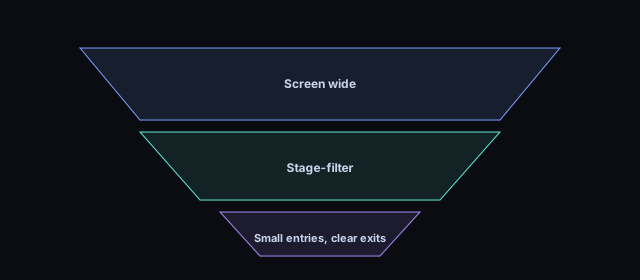
Stage-based investing rests on a simple premise: buying stocks that are in uptrends, have broad technical confirmation, and are outperforming the market tends to produce better outcomes than buying stocks in downtrends or hoping for reversals.
This isn’t a secret. Institutional investors have applied variations of this logic for decades. What TRINITY does is automate the scanning, computation, and signal generation so you can apply this discipline consistently across a large universe of stocks—something that would be impractical to do manually.
The hypothesis can be stated as a filter:
- The stock is in Stage 2 (uptrend, not distribution or decline)
- Technical indicators broadly confirm the trend (SATA 7+)
- The stock is outperforming the market (positive Mansfield RS)
- The signal agrees (BUY or ADD)
- The broad market environment is not hostile (not Stage 3/4 at index level)
When all five filters align, you are looking at the highest-quality setup the framework can identify. When they don’t all align, that’s information—not a reason to force the trade.
Building a screening workflow
A screening workflow is a systematic process for narrowing a large universe of stocks down to a focused shortlist worth researching in depth. Here’s how to structure one using TRINITY’s tools:
Step 1: Stage filter
Goal: Eliminate stocks not in Stage 2 (or late Stage 1 approaching breakout).
Start by filtering your universe to stocks classified as Stage 2 (or Stage 1A/1B if you’re looking for pre-breakout setups). This immediately eliminates the majority of the universe—stocks in Stage 3 distribution and Stage 4 decline are not candidates for new long entries in this framework.
Step 2: SATA filter
Goal: Confirm technical quality within the Stage 2 group.
From your Stage 2 list, filter for SATA ≥ 7 (strong). This removes Stage 2 stocks where the technical confirmation is weak or mixed. You are now looking at stocks where stage and indicators are aligned.
For the most conservative setups, use SATA ≥ 8. For watchlist building where you’re willing to monitor developing situations, SATA ≥ 6 is acceptable—but flag those as requiring further development before action.
See The SATA score for component-level detail.
Step 3: Mansfield RS filter
Goal: Confirm market outperformance.
From your filtered list, look for positive Mansfield RS. This confirms that the stock’s move is genuine leadership, not just rising with a bull tide.
For the highest conviction, look for Mansfield RS ≥ 25. Stocks well above the benchmark tend to continue outperforming in the near term—this is the momentum effect at work.
See Relative strength and Mansfield RS for full context.
Step 4: Signal check
Goal: Verify the model agrees.
Check the signal on each remaining candidate. You want BUY (HIGH confidence) or BUY (MODERATE confidence). ADD signals on existing positions are also relevant here. HOLD signals mean the setup is developing but not ready.
Dismiss any BUY signal with LOW confidence until additional data is available.
Step 5: Market context check
Goal: Validate the macro environment supports the setup.
Before acting on any individual setup, assess whether the broad market is in a Stage 2 or early Stage 1 environment. A Stage 2 stock screened through all four filters above faces significantly different risk in a bull market vs a bear market.
In unfavorable market conditions, apply all filters more strictly (SATA 9+, Mansfield RS 40+) or simply reduce position sizes materially.
See Understanding market conditions.
Using Hunt and Watchlists to surface candidates
The screening workflow above describes what to look for. TRINITY’s tools help you find it:
Hunt surfaces stocks and portfolio changes that may align with your goals, using stage analysis as a core input. If Hunt recommends a stock, check whether it passes your own filter criteria before acting. Use Hunt as a discovery mechanism, not a rubber stamp. See Hunt, Cash Hunt, and optimization.
Watchlists let you monitor a curated set of stocks as they move through stages. A common workflow: add Stage 1 stocks showing improving Mansfield RS to a watchlist, then act when they trigger a Stage 2 classification with SATA and signal confirmation.
Batch analysis runs the full ATHENA analysis across multiple symbols, producing stage labels, SATA scores, and signals for each. Use batch analysis to re-evaluate a larger universe periodically—weekly or after major market moves.
Entry discipline: when to pull the trigger
Having a good setup is necessary but not sufficient. Entry discipline—knowing when to actually enter a position—is equally important.
Wait for confirmation, don’t anticipate it. The most common mistake in stage-based investing is entering a Stage 1 stock before it has confirmed Stage 2. The signal will tell you when the model sees Stage 2 with confirmation. Jumping in early because “it looks like it’s about to break out” means you’re taking on more risk without the confirmation the framework is designed to provide.
Check the chart. Signals are generated from indicator data; they don’t “see” the price chart as a human does. Spend time looking at the actual chart before entering. Does the price action look clean? Is there a clear base? Is the breakout happening on meaningful volume?
Don’t chase. If a stock triggered a BUY signal 10% ago and has already had a significant run, re-evaluate whether the current price represents a good risk/reward for a new entry. The signal was accurate at the time; that doesn’t mean it’s appropriate to chase after the move has already happened.
Size for conviction and stage. Stage 2A (fresh breakout) positions carry more execution risk than Stage 2B (established trend). Start with smaller positions on fresh breakouts and add if and when the trend confirms. See Position sizing for foundational concepts.
Position sizing with stage context
Stage context is useful information for sizing decisions. A framework:
| Setup quality | Suggested position approach |
|---|---|
| Stage 2B, SATA 9–10, RS 40+, HIGH confidence BUY, bull market | Full intended position |
| Stage 2A, SATA 7–8, RS 15–25, MODERATE confidence BUY | Starter position (50–75% of intended); add on confirmation |
| Stage 2, SATA 6, RS marginal, LOW confidence BUY | Watchlist only; wait for improvement |
| Stage 1B approaching breakout, developing SATA | Watchlist only; no position until Stage 2 confirms |
“Full intended position” is a relative concept—your maximum position size should already be defined by your risk management rules (see below). This table governs what fraction of that maximum to deploy at entry.
Exit discipline: the other half of the trade
Most frameworks spend significant energy on entries and little on exits. Stage-based investing has clear exit logic:
The REDUCE signal is a prompt to review, not ignore. When a stock you own moves from Stage 2 to generating REDUCE signals, that is the model telling you the balance of evidence is shifting toward deterioration. Don’t rationalize holding. Trim the position; let the remaining shares run with a tighter mental stop.
The SELL signal is a prompt to exit. Stage 4 classification with a SELL signal means the model sees broad indicator confirmation of a downtrend. Acting on SELL signals can feel wrong in the moment (the stock may bounce after you sell), but disciplined exit adherence is what prevents Stage 4 losses from becoming catastrophic.
Plan your exit at entry. Before entering any position, decide:
- At what point is my thesis wrong? (price level, stage change, signal flip)
- What will I do when that happens? (full exit, partial trim, review)
Having the exit plan before you’re in the trade removes emotion from the decision.
Time is also an exit signal. If you entered a position expecting a Stage 2 advance and the stock has done nothing for months while its SATA has declined, that is information. Time spent in a position with no progress is an opportunity cost. Stage-based investing involves not just avoiding Stage 4—it also means not being stuck in long Stage 1 basing phases when better setups exist elsewhere.
Portfolio-level thinking
Individual stock analysis is insufficient without portfolio-level awareness:
Diversify across sectors. A portfolio of 10 Stage 2 stocks all in the same sector is not diversified—it’s a sector bet. Aim for Stage 2 leadership spread across different industry groups. When one sector rotates to Stage 3, your other positions provide a buffer.
Limit single-name concentration. Even the highest-conviction Stage 2, SATA 10, RS 60 setup should be capped at a reasonable percentage of your portfolio. Concentration risk is real; unexpected events can hit even technically perfect setups.
Track portfolio-level stage distribution. If most of your holdings are moving toward Stage 3, that’s a portfolio signal even if each individual position still looks okay. The aggregate tells a story the individual doesn’t.
Cash is a position. In adverse market conditions or when your screening workflow isn’t generating quality candidates, holding cash is a valid strategy. A portfolio that is 100% invested in a Stage 3/4 market is exposed; a portfolio with 30% cash has optionality when the next Stage 1 → Stage 2 cycle begins.
Common mistakes to avoid
Buying Stage 1 too early. Stage 1 stocks look cheap; they’ve already fallen. But a “cheap” stock in Stage 1 can fall much further before establishing a base. Wait for Stage 2 confirmation.
Holding through Stage 3 and 4. Hope is not a strategy. When ATHENA flags Stage 3 deterioration on a position you hold, that’s a prompt to act—not to wait and see.
Over-diversifying into mediocre setups. Ten positions at SATA 6 are not better than five positions at SATA 9. Quality beats quantity in stage-based investing.
Ignoring the market regime. Individual stock analysis in a vacuum, divorced from market conditions, leads to fighting the tape. Always situate your setups in the broader market environment.
Treating signals as guarantees. Every TRINITY signal is a probability estimate based on historical patterns. The market will occasionally produce outcomes that defy the analysis. Manage risk accordingly.
Connecting to broader TRINITY workflows
Stage-based investing doesn’t exist in isolation within the platform:
- DIONYSUS (optimization): The portfolio optimizer can help balance position weights across your stage-based selections. Feed it your screened candidates and let it propose portfolio construction under your risk constraints. See Allocation strategies.
- ARES (automated trading): For users who want to automate execution, ARES can act on signal-based criteria. This requires careful configuration of safeguards and position limits. See Automated trading with TRINITY.
- Risk management: Stage analysis is a risk filter, but not a complete risk management framework. Combine with position size limits, drawdown controls, and diversification rules. See Risk management fundamentals.
This lesson describes an educational framework for applying stage analysis concepts. It is not a trading strategy, a proven investment system, or personalized financial advice. Past patterns in market behavior do not guarantee future results. All investments carry the risk of loss. See Disclosures.
Progress is saved in this browser. Cloud sync requires PUBLIC_IRIS_API_BASE, IRIS CORS allowlist,
and window.__trinityIdToken.